
Mangrove Forest of Sundarbans
A Journey Through Nature's Green Wonderland — the world's largest tidal halophytic delta where trees breathe through their roots, tigers swim rivers, and the ocean meets the jungle.
When People Think of Sundarbans, Think Beyond the Tiger
When people think about the Sundarbans, the first thing that usually comes to mind is the Royal Bengal Tiger. However, the true heart of this incredible ecosystem is the mangrove forest itself — a living, breathing labyrinth of tangled roots, tidal creeks, and extraordinary botanical adaptations that no other forest on Earth can match.
The Sundarbans mangrove forest spans approximately 10,000 square kilometres across India and Bangladesh, making it the single largest contiguous tidal mangrove ecosystem on the planet. Recognised as a UNESCO World Heritage Site and a Ramsar Wetland of International Importance, it is also one of the world's most significant carbon sinks, sequestering carbon at rates far exceeding that of terrestrial forests.
What makes this forest truly extraordinary is not just its scale, but its survival mechanisms. Every tree species here has evolved remarkable strategies to live in an environment that alternates between saltwater inundation and dry air — a challenge that no ordinary plant can overcome.
Key Highlights
- World's largest tidal halophytic delta
- Unique pneumatophore (breathing root) system
- Home to 35+ mangrove tree species
- Sundari, Gewa, Goran & Golpata flora
- World's largest coastal carbon sink
- Only mangrove habitat with wild tigers
- 260+ resident & migratory bird species
- 400+ tidal rivers & interconnected creeks
Visit the Forest
Experience this UNESCO wonder on a guided boat safari
Chat With Our GuideView Tour PackagesThe Miracle of Breathing Roots
How does a tree survive with its roots permanently submerged in salty mud?
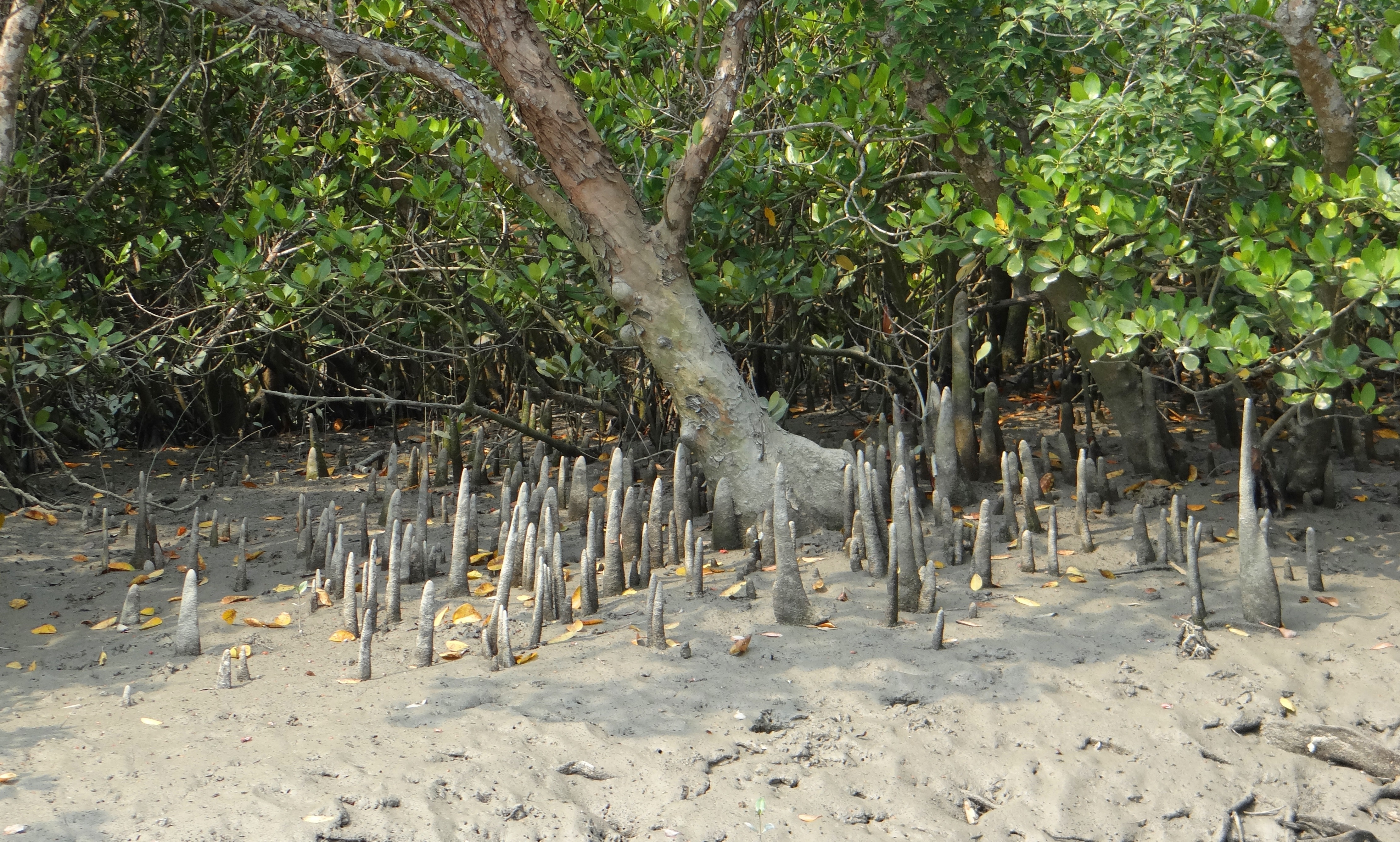
The defining visual of any Sundarbans mangrove forest is the extraordinary forest floor — carpeted with thousands of pencil-like spikes jutting upward from the mud. These are pneumatophores, specialised root structures evolved exclusively by mangrove trees to breathe in an anaerobic (oxygen-free) waterlogged environment.
As the tide rises, the pneumatophores submerge. But tiny pores called lenticels at the tip of each spike have already absorbed enough atmospheric oxygen to supply the root system during full submersion. When the tide falls, the cycle resets.
Walking through a mangrove forest at low tide feels like walking through a petrified army of miniature spears — thousands per square metre, each one a testament to millions of years of botanical evolution.
Lenticel Pores
Microscopic openings that open during low tide to absorb oxygen — and seal shut at high tide to prevent water ingress.
Salt Exclusion
Mangrove roots actively filter up to 90% of seawater salinity — acting as living reverse-osmosis membranes.
Viviparous Seeds
Sundarbans mangroves germinate their seeds while still attached to the parent tree, producing ready-to-plant seedlings called propagules.
Cyclone Shield
This root network has protected coastal villages from the full fury of Bay of Bengal cyclones for centuries — a natural seawall of living wood.
The Four Pillars of the Sundarban Forest
Among 35+ mangrove species, these four define the Sundarbans' character — each with a unique ecological role and fascinating story.
Sundari (Heritiera fomes)
The most iconic tree of Sundarbans, giving the forest its very name. Sundari trees grow tall and slender with buttress roots, thriving in moderately saline zones. Their dense hardwood canopy forms a dark-green ceiling over the tidal channels.
Gewa (Excoecaria agallocha)
Locally called 'dhundul', this tree produces a caustic milky latex that can cause temporary blindness on contact — a fascinating adaptation for repelling herbivores. It is one of the most abundant species in the lower salinity zones of the delta.
Goran (Ceriops decandra)
Found in highly saline tidal zones, Goran forms impenetrable thickets where tigers prefer to rest. Its bark is used by indigenous fishermen to tan fishing nets. It is a critical roosting habitat for rare shorebirds.
Golpata (Nypa fruticans)
The only true palm adapted to mangrove conditions, Golpata's broad fan-shaped fronds are used by local Munda and Bawali communities to thatch roofs and weave traditional baskets — a living, breathing connection between ecology and culture.
Wildlife of the Mangrove Delta
The Sundarbans mangrove forest is as much about the animals as the trees. Every species here has evolved unique adaptations to the tidal, brackish world they inhabit.
Royal Bengal Tiger
Panthera tigris tigris
The Sundarbans tiger is the world's only population adapted to swimming in saltwater. They are frequently spotted crossing rivers and waterways — a behaviour unique to this habitat.
Estuarine Saltwater Crocodile
Crocodylus porosus
The world's largest living reptile thrives in the brackish tidal creeks. Sundarban crocodiles can reach 6 metres in length and are apex ambush predators of the delta waterways.
Irrawaddy Dolphin
Orcaella brevirostris
Endangered Irrawaddy dolphins are spotted in the wide river mouths of Panchamukhani. Unlike most dolphins, they lack a prominent beak and swim with slow, deliberate movements.
White-bellied Sea Eagle
Icthyophaga leucogaster
One of 260+ bird species that inhabit or migrate through the Sundarbans, the White-bellied Sea Eagle is frequently spotted diving for fish along the tidal creeks during dawn boat safaris.
Bengal Monitor Lizard
Varanus bengalensis
Monitor lizards are expert climbers and swimmers — often spotted basking on mangrove roots or swimming across channels. They are vital scavengers that maintain the forest's ecological balance.
Mudskipper
Periophthalmus spp.
These extraordinary amphibious fish 'skip' across mudflats using their pectoral fins as crutches. A symbol of tidal zone adaptation, mudskippers breathe through their moist skin when out of water.
Photographed at Sajnekhali
Dense pneumatophore root carpet at low tide
A Forest Under Both Protection & Threat
The Sundarbans is simultaneously one of the most protected and most threatened ecosystems on Earth. It is safeguarded by multiple designations: UNESCO World Heritage Site (1987), Ramsar Wetland (1992), Tiger Reserve, and a declared Biosphere Reserve — yet rising sea levels from climate change threaten to submerge significant portions of the delta within decades.
The forest faces pressures from fishing community encroachment, illegal poaching, honey-collecting incidents, and the increasing intensity of Bay of Bengal cyclones. Cyclone Amphan (2020) caused catastrophic damage, uprooting thousands of ancient mangrove trees.
Responsible ecotourism — arriving with certified naturalist guides and following Forest Department rules — directly funds conservation, ranger patrols, and the local communities who are the forest's best long-term guardians.
How to Experience the Mangrove Forest
Best Season to Visit
October to March is the ideal window. Monsoon (June–Sep) brings flooding that restricts movement. Winter months offer calm river conditions, clear sightings, and comfortable temperatures of 15–28°C.
Entry Requirements
All visitors require a permit issued by the West Bengal Forest Department. Indian nationals and foreign tourists have separate permit categories. Permits are included in all Go Sundarban Tour packages — no separate queuing needed.
Guided Boat Safari
The only way to enter the core mangrove zones is by authorised vessel with a certified naturalist guide. Our motorised wooden houseboats cruise the tidal creeks — the best vantage point for watching forest life at water level.
Ready For Your Unforgettable Sundarban Safari?
Reserve your seats today with a minimal advance. Certified naturalist guides, luxury river vessels, and authentic Bengali feasts await you.